
Dover sits in central Hillsborough County, positioned between Tampa and Plant City in a part of Florida where the air feels thick for most of the year. The combination of agricultural surroundings, proximity to wetland areas, and the general humidity that characterizes this region creates an environment that is particularly demanding on air conditioning equipment. Of all the maintenance factors that affect how well an AC system performs in conditions like these, coil cleanliness is one of the most direct.
When coils are clean, heat transfer happens efficiently, and the system does what it was designed to do. When they are coated in dust, biological growth, or debris, that process degrades in ways that show up as higher energy bills, reduced comfort, and added strain on the system’s most expensive components. Understanding how humidity shapes that process in Dover, FL, specifically, and what professional coil maintenance actually addresses, helps homeowners make better decisions about their system’s care.
Why Humidity Makes Coil Maintenance More Demanding
Air conditioners do two things simultaneously. They lower the temperature, and they remove moisture from the air. In a high-humidity environment like Dover, the moisture removal side of that equation is working harder than it would in a drier climate, and that workload has a direct effect on the evaporator coil.
The evaporator coil surface is cold. Warm, humid air passes over it, the refrigerant inside absorbs the heat, and moisture from that air condenses on the coil surface, drains away through the condensate system, and is removed from the indoor environment. That condensation process is continuous during Florida’s long cooling season, and a coil surface that is wet for extended periods becomes a surface where biological growth can take hold.
In our service calls throughout Dover and the surrounding central Hillsborough County area, evaporator coils with visible mold or mildew accumulation are a consistent finding, particularly in systems that have not been serviced in a year or more. The combination of moisture, organic material from airborne dust and debris, and temperatures that favor biological growth creates conditions where a clean coil can develop significant accumulation within a single season.
What Accumulates on Each Coil Type
The evaporator coil and the condenser coil face different accumulation challenges, and maintaining both requires understanding what each one is dealing with.
Evaporator Coil Buildup
The evaporator coil sits inside the air handler and is exposed to whatever is in the air flowing through the system from inside the home. Dust, pet dander, pollen, mold spores, and other airborne particles that pass through or around the filter settle on the coil fins over time. In humid conditions, those particles bond to the moisture on the coil surface and accumulate into a layer that increasingly restricts airflow and reduces heat transfer efficiency.
A coil with significant buildup loses its ability to absorb heat effectively. The system compensates by running longer, which adds to the moisture accumulation problem and creates a cycle where conditions worsen progressively without intervention.
Condenser Coil Buildup
The condenser coil in the outdoor unit faces a different environment. Dover’s combination of agricultural activity, surrounding vegetation, and general outdoor debris means outdoor units are exposed to dust, pollen, grass clippings, cottonwood, and other material that accumulates on the condenser fins. Units near fields or tree lines see higher rates of accumulation than those in more sheltered locations.
A condenser coil that is partially blocked cannot release heat into the outdoor air efficiently. System pressures rise, the compressor works harder, and efficiency drops. During peak summer heat in Dover, FL, a dirty condenser coil compounds the challenge the system already faces operating in high ambient temperatures.
The Professional Cleaning Process
Coil cleaning is best handled by a professional rather than as a DIY project, and the reasons go beyond basic access limitations. Both coil types require specific cleaning agents, correct application methods, and careful handling of delicate aluminum fins that bend easily and cannot be straightened without specialized tools.
A proper AC coil cleaning visit covers the following:
The evaporator coil is accessed through the air handler cabinet. A qualified technician inspects the coil for buildup type and extent before selecting the appropriate cleaning agent. Foaming coil cleaners are common for moderate accumulation. More significant biological growth may require different treatment. The condensate drain pan and drain line are cleared of standing water and buildup, since a blocked drain can cause water to back up into the air handler and contribute to further moisture problems.
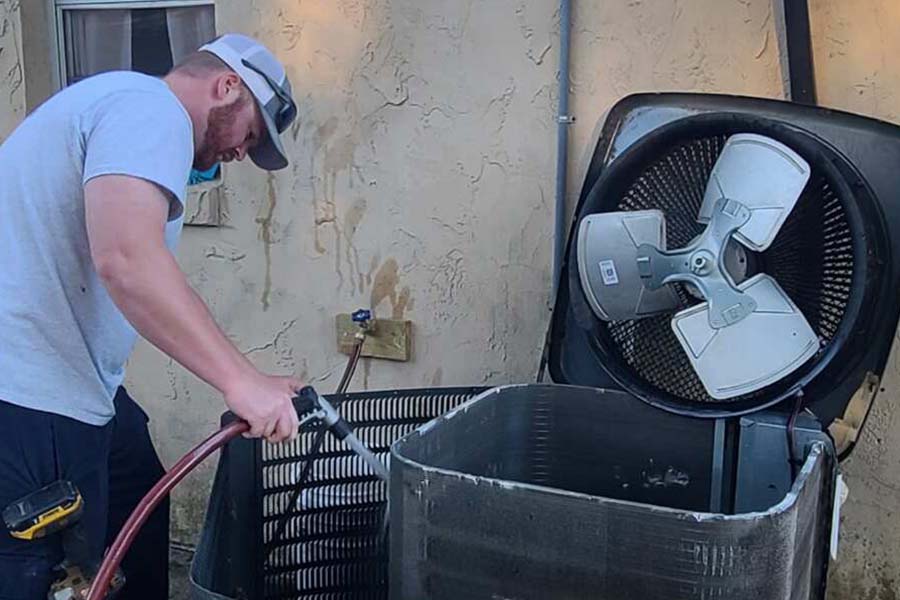
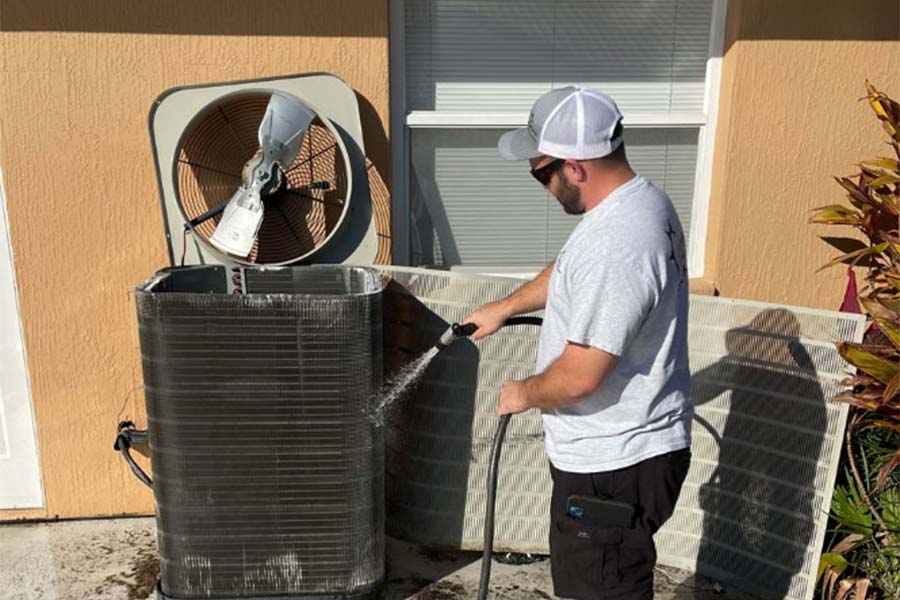
The condenser coil is cleaned from the outside. Fins are rinsed carefully to remove surface debris, and any obstructions to airflow around the unit are identified and noted. Fin condition is assessed, since damaged or bent fins reduce the coil’s effective surface area for heat transfer.
A thorough visit also includes a check of refrigerant pressure, a review of airflow through the system, and documentation of any other conditions observed during the service.
Signs That Coil Cleaning Is Overdue
Homeowners in Dover, FL, are not typically positioned to inspect their coils directly, since the evaporator coil sits inside the air handler and the condenser fins are dense enough that surface buildup is not always obvious from a distance. Performance-based indicators are usually the more practical signal.
Working in homes across Dover, the patterns that consistently point back to coil-related issues include the following:
- The system runs noticeably longer cycles than it did in previous seasons without a change in thermostat settings
- Certain rooms are consistently harder to cool than the rest of the home
- A musty or stale odor appears when the system runs, which often indicates biological growth on the evaporator coil
- Energy bills have increased compared to the same period in prior years without a clear explanation
- Ice is forming on or near the indoor unit, which suggests restricted heat absorption at the evaporator coil
Any of these, particularly more than one occurring simultaneously, suggests that a coil inspection and likely a cleaning is worth scheduling rather than deferring.
How Coil Condition Connects to the Whole System
A dirty coil does not operate as an isolated problem. Its effects extend to components throughout the system, and the compressor bears the most significant share of that extended stress.
When the evaporator coil cannot absorb heat efficiently, the refrigerant returning to the compressor is warmer than it should be. The compressor operates under elevated pressures and temperatures as a result. Over time, that added thermal and mechanical stress accelerates wear on a component that is expensive to repair or replace.
This connection between coil cleanliness and compressor health is one of the more practical arguments for keeping coil cleaning on a consistent schedule. The cost of a routine AC maintenance visit that includes coil inspection and cleaning is considerably lower than an AC repair visit addressing compressor damage that developed in part because the coils were not being maintained.
In Dover’s climate, where systems run heavily from late spring through early fall, the cumulative effect of a single season with dirty coils adds meaningful wear to the system’s most expensive components.
Frequency Considerations for Dover’s Environment
The general guidance of annual coil cleaning holds as a baseline, but Dover’s specific conditions suggest that more frequent attention may be warranted for some systems. Homes near agricultural fields, unpaved roads, or tree lines with significant pollen output may see condenser coil accumulation faster than homes in more sheltered or urban settings.
Systems serving households with multiple pets or high occupant counts tend to show faster evaporator coil accumulation as well, since the volume of airborne particles passing through the system is higher.
A technician who can assess coil condition at the time of a service visit is the most reliable guide to how frequently your specific system needs cleaning. Some systems in Dover’s environment benefit from twice-yearly attention to the condenser coil, particularly before the peak cooling season and again in the fall when organic debris from surrounding vegetation is highest.
Keeping Airflow Strong Through Dover’s Humid Season
Coil maintenance is not a dramatic or complicated subject, but it has a consistent and measurable effect on how well an air conditioning system performs. In a high-humidity environment like Dover, where conditions favor accumulation and biological growth on coil surfaces, keeping up with this aspect of system care is one of the more direct ways to protect both comfort and equipment longevity.
Egberts Electric and Air Conditioning serves Dover and the surrounding central Hillsborough County area. Contact our team today to schedule a coil inspection and find out where your system stands heading into the season.